


In pharmaceutical production, heat transfer is involved in almost every stage of the process — pasteurization, concentration, crystallization, sterilization, post-reaction cooling. The heat exchanger is a basic piece of equipment, typically selected once and forgotten about until something stops working properly.
The problem builds gradually. Thermal efficiency drops, cleaning intervals get shorter, utility consumption rises, and at some point the CIP protocol stops restoring the original performance. The usual diagnosis is that the equipment “wore out” — in reality, more often than not, the equipment was never the right fit for the product being processed in the first place.
What Happens on the Heat Transfer Surface
Thermally processed pharmaceutical products — concentrated extracts, syrups, active ingredient suspensions, emulsions, protein solutions — share a common trait: they tend to deposit on the hot surfaces of the exchanger. This buildup forms a layer with low thermal conductivity that acts as an insulator. The thicker the layer, the harder the equipment has to work to achieve the same thermal result.
In a conventional plate heat exchanger, the narrow channel geometry makes the problem worse. Fluid velocity drops in the areas where flow direction changes, particles settle out, proteins denature and stick at elevated temperatures, and sugars caramelize locally. This isn’t a malfunction — it’s a direct consequence of a mismatch between the equipment’s design and the properties of the fluid being processed.
Why This Matters More Than It Seems in Pharma
In a pharmaceutical plant, a heat exchanger that accumulates deposits raises issues that go well beyond energy efficiency.
The first is cross-contamination risk between batches. Residual deposits on heat transfer surfaces can contain active ingredients from the previous batch. If the CIP protocol fails to fully remove these deposits — and the more layered they become, the harder they are to clean — there is a real risk of product carryover between batches, with direct implications for compliance.
The second is CIP validation. A GMP auditor reviewing the heat transfer line will ask how you demonstrate that surfaces are clean after every cleaning cycle. The more a surface tends to accumulate deposits, the harder and more costly that demonstration becomes to sustain over time.
The third is product stability. Localized overheating in areas with deposits can degrade thermally sensitive active ingredients, affecting the stability profile of the finished product.
How to Fix the Problem at the Source
More frequent cleaning treats the symptom, not the cause. The real solution is to choose equipment designed so deposits don’t form in the first place.
Scraped surface heat exchangers work on a different principle than conventional units: a moving mechanical element continuously cleans the heat transfer surface during operation. Deposits never get the chance to build up, the heat transfer coefficient stays stable throughout the production cycle, and the intervals between cleanings extend significantly.
For pharmaceutical processes, the operational benefit comes paired with a compliance one: a surface that doesn’t accumulate deposits during the process is easier to validate from a CIP standpoint, and demonstrating cleaning effectiveness becomes simpler and more robust.
There’s also a secondary advantage relevant to pharma: the continuous motion of the scraper keeps the product agitated, evens out the temperature throughout the fluid mass, and prevents localized overheating — critical in processes with narrow temperature windows or thermally sensitive active ingredients.
When It’s Time to Reassess Your Current Equipment
If cleaning intervals have shortened relative to the original design parameters, the first step is root-cause analysis — a change in product composition, a shift in process parameters, or a fundamental mismatch between equipment and fluid. If the analysis confirms that the current equipment isn’t compatible with process requirements, replacing it or supplementing it with a scraped surface heat exchanger removes a recurring source of operational and compliance problems.
How Consultech Can Help
Consultech distributes the full range of HRS heat exchangers in Romania — a company with over 40 years of experience in demanding process applications, specialized in heat transfer technologies for industries with high hygiene and compliance requirements.
For pharmaceutical production, HRS offers two scraped surface technologies matched to the type of problem:
The Unicus Series — a patented scraped surface heat exchanger with reciprocating motion, designed for viscous products or those with a high tendency to foul. The scraper moves back and forth along the heat transfer tube, keeping the surface clean and the fluid in continuous motion. Its gentler action makes it the preferred choice where product integrity matters — for extract concentration, active ingredient suspensions, or shear-sensitive formulations.
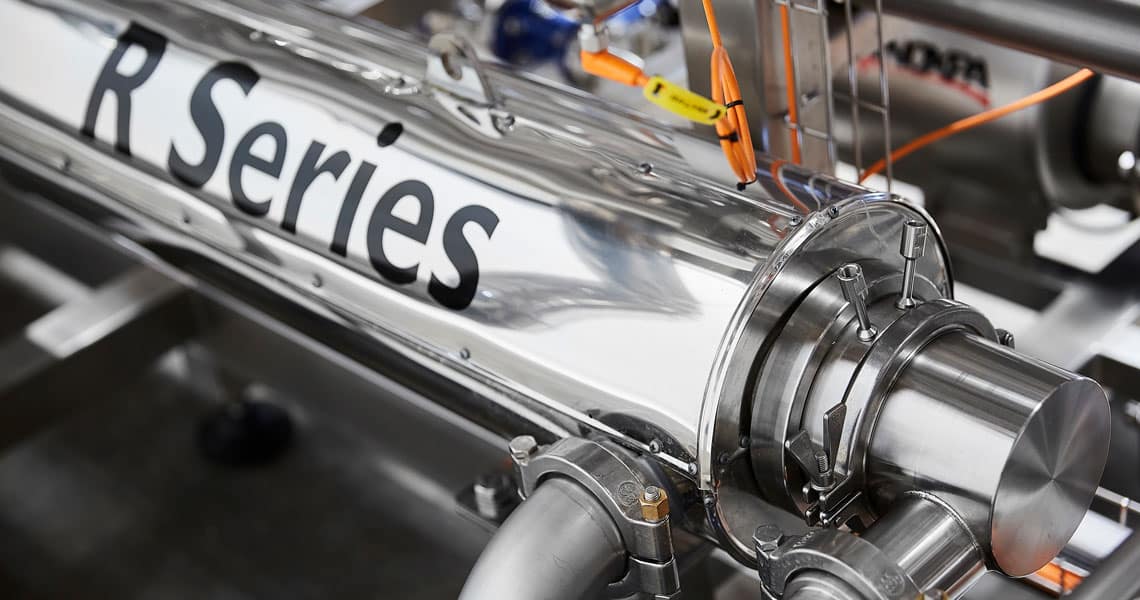
The R Series — the same scraped surface principle, with rotary motion instead of reciprocating. The rotary scraper can reach speeds of up to 300 rpm, producing higher shear and mixing at the heat transfer surface. It’s the preferred option for the most demanding applications — very high viscosities and strongly fouling fluids — or where the product actually benefits from more vigorous mixing.
Both series are built from pharmaceutical-grade materials, with no dead zones, and validatable CIP cleanability — requirements that aren’t optional extras at HRS for pharma applications, but the design standard.
Consultech provides technical evaluation of the application, equipment selection based on the actual properties of the fluid, installation, commissioning, and ongoing technical support — genuine HRS spare parts from our own stock, plus planned and emergency service interventions.
If you’re dealing with a heat transfer process with recurring fouling issues or CIP validation challenges, contact us for a technical assessment.
A Consultech engineer will respond within 48 hours.
